“The earth under our feet is too often ignored by policymakers,” said Maria-Helena Semedo of the Food and Agriculture Organisation (FAO) at a 2014 summit on the global depletion of soil—an issue described in a recent UN report as one of the most urgent ecological crises facing the planet today.
Yet soil scarcity has long been a reality in the Indian mountain city of Leh: perched at an altitude of around 12,000 ft, its position in a rain shadow cast by the towering peaks of the Himalayas has forced many of its inhabitants to navigate life with uneasy access to water or fertile ground for centuries.
The environmental challenges facing Himalayan mountain communities is a chief concern of sā Ladakh in Leh—the highest exhibition of land art in South Asia, which opened its inaugural edition this month. Its name derives from Ladakh, India’s northernmost territory, of which Leh is the joint capital, and sā, the Ladakhi word for soil. A first-of-its kind show in the region, it will “foster a dialogue on climate-related issues” and “explore the role of art in a unique and fragile ecosystem”, its organisers say.
sā Ladakh is held in the Disko Valley
© Raki Nikahetiya
For the exhibition, a group of Ladakhi and international artists have created ten site-specific sculptures and installations in the Disko Valley: a remote, 20-acre plot of arid land surrounded by steep hills, which was once popular with hash-smoking tourists and more recently, mountain bikers. In keeping with the show’s sustainability aims, the works are virtually all made from locally sourced, zero-waste materials, which have been salvaged or repurposed and are biodegradable. “We want to leave as little trace as possible,” says one of the show’s co-founders, the designer Sagardeep Singh.
A number of films and virtual reality (VR) works are also being shown over the course of the exhibition, some projected onto the rugged rock faces scattered across the site. After the show closes, all the physical works will either be repurposed, disintegrate over time, or stay as permanent installations in the valley.
Central to the show’s critique is how Ladakh’s longstanding water scarcity is being further strained to unsustainable levels by mounting development and tourism in the region; around half the works comment on this issue. “Ladakh is a beautiful but highly fragile place,” says the artist Anayat Ali, who is based in Kargil, western Ladakh. He presents a group of carefully balanced stone structures that “with one push can be as easily destroyed” as his homeland. “Ladakh can barely sustain its own population. This mass influx of outsiders is harmful, we must act now,” he says.
Figures for Ladakh tourism have snowballed in the past four years, and reportedly hit an all-time high in 2022, with Leh alone seeing 250,000 visitors that year—almost ten times its 30,000 permanent population. Projected figures for 2023 are set to break this record, to numbers that are “worrying considering the ecological vulnerability of the region,” says Kunzang Deachen, a member of the responsible tourism NGO Local Futures Ladakh, which is partnering with the exhibition.
The group is supporting the artist Tundup Gyatso to create Kicker of Plastics, a large bike ramp made from thousands of discarded single-use plastic items “collected in a single week from Leh”—a commentary on the “toxic environment created by the existing tourism sector in Ladakh,” Gyatso says.
Who owns Ladakh?
Many of the works in sā Ladakh convey the ‘what’ of the region’s current environmental crisis, and, by addressing unsustainable tourism and building projects, to some extent the ‘who’. Less immediately apparent is the ‘why’ behind this rampant development. The clearest example of this comes from the Delhi-based artist Vibha Galhotra, whose hillside textile installation arranges secondhand saris and other garments destined for landfill to spell: “YOU DON’T OWN ME”. The work asserts that our current era of “global boiling” stems from an imbalanced consumption of natural resources by those in power, Galhotra says. It also broaches Ladakh’s position as “a border land under political threat”, providing an important link between the show’s expressed ideals and the region’s charged politics.
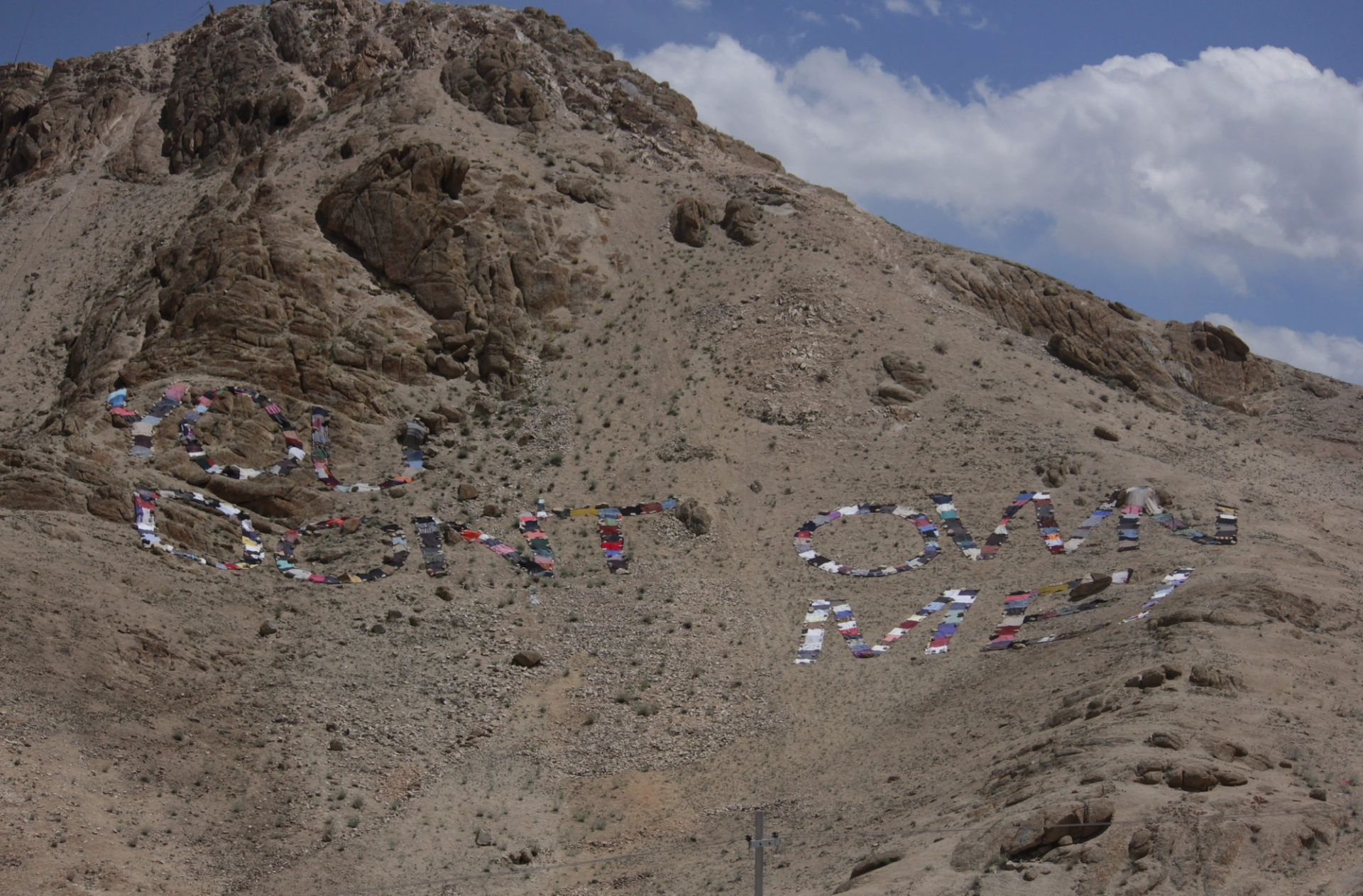
Vibha Galhotra’s YOU DON’T OWN ME (2023)
Courtesy of sā Ladakh
Ladakh was until recently part of the semi-autonomous Indian state Jammu and Kashmir, bordering Pakistan to the east and China to the west; India has tense relations with both nations and contests the limits of these borders. In August 2019, the home ministry controversially revoked this semi-autonomous status and bifurcated the state into Jammu and Kashmir, and Ladakh. At this time, Ladakh was turned into a union territory—an administrative division without its own separate government—tying its policies much closer to New Delhi’s.
While this move was initially welcomed by many Ladakhis concerned with Kashmir’s dominance over state politics, since 2019, a movement for autonomy has swelled. And at its centre are concerns over development projects being greenlit by the national government since Ladakh came under its direct rule.
According to Scroll India, between 2015 to 2019, Ladakh signed four agreements with public and private sector companies to set up projects in the region. In comparison, at least ten such projects have been approved in the last two years.
The rise in tourism is also linked to recent infrastructure projects. A report last year in the environmental science journal Mongabay states that a road tunnel built in the neighbouring state of Himachal Pradesh in 2020 has allowed for a 400% increase in vehicular traffic, much towards Leh, with around 80% of this traffic attributed to tourism, according to Manav Verma, superintendent of police for Lahaul and Spiti. He told Mongabay that there has been “an unprecedented increase in traffic inflow ever since the nine-kilometre-long Atal Tunnel was made open for the public”, which allows “tourists [to travel] even during winters, which is happening for the first time”.
Militarised mountains
But publicly broaching these issues is a risky undertaking: Ladakh’s position at the frontier of two contested borders makes it one of India’s most militarised and surveilled regions. Perhaps the most public chapter of the protests has been a series of climate fasts by the education reformist Sonam Wangchuk, the most recent of which took place in June. Wangchuk hopes to draw attention to the fragility of Ladakh’s ecology and demand its inclusion in the Sixth Schedule of the Indian constitution, which grants a degree of self-governance to the nation’s tribal majority regions.
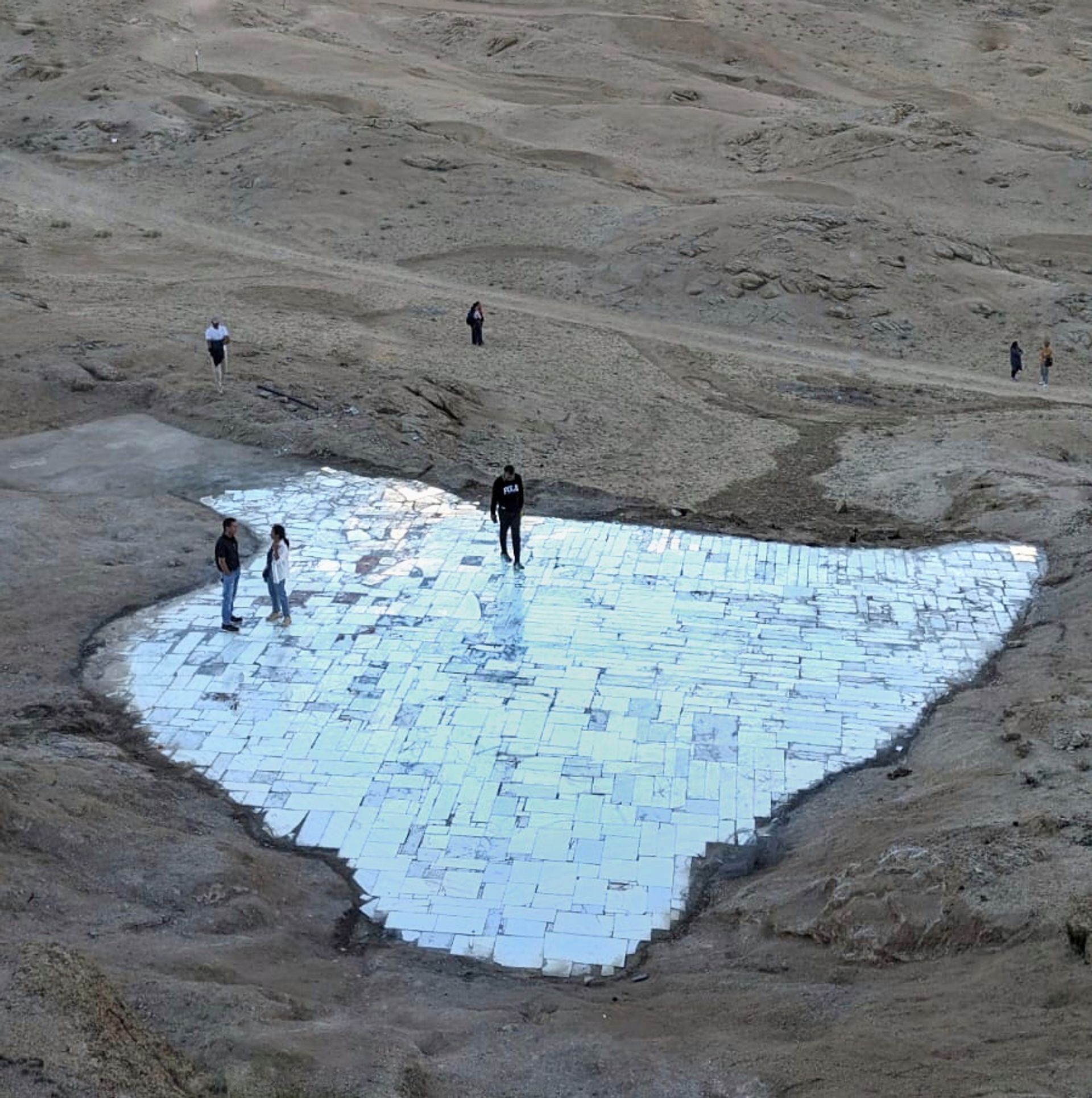
Tsering Gurmeet Kungyam’s installation at sā Ladakh
Courtesy of sā Ladakh
According to the sā Ladakh co-curator Monisha Ahmed, who in 2010 founded the region’s only contemporary arts space, the Ladakh Arts and Media Organisation (Lamo), to her knowledge no local artists have made work in direct response to the recent movement for greater autonomy.
It appears that this is not due to disinterest, but self-censorship. One of the Ladakhi artists taking part in the exhibition, Tsering Gurmeet Kungyam, shows an expansive mirrored floor installation meant to resemble a lake. It pertains to local folklore, and, of course, water scarcity. Kungyam says that he wants to make work that is even more explicitly political around these issues, “but India’s current government is so bad they can do anything to harm a single artist”.
Climate optimism
In this context, sā Ladakh’s subtle approach to charged issues is pragmatic. Rather than focusing on politics, its organisers prefer for their show to be understood through “climate optimism”, which includes thinking of solutions related to sustainable tourism, and “promoting contemporary art in Ladakh, something which is in its early stages,” says the exhibition’s co-founder Raki Nikahetiya. “We can’t influence what people associate us with. But we try to be clear that our land art exhibition is not related to activism or contemporary political movements but art and awareness raising,” he says.
Nikahetiya adds that this show will hopefully be the first in a series that could travel across India, and even the world. “The rise in tourism and urbanisation, as well as receding glaciers drastically changing weather patterns, are not localised issues. Whether you are in Ladakh or in the European Alps, we experience the same phenomenons”.
Encouraging collaborative thinking between different geographies is key to the exhibition’s aims, Nikahetiya says. Indeed, Ladakh has for decades been held as a model of sustainability, with its challenging climate conditions having encouraged zero-waste lifestyles long before such concepts were part of a global conversation.
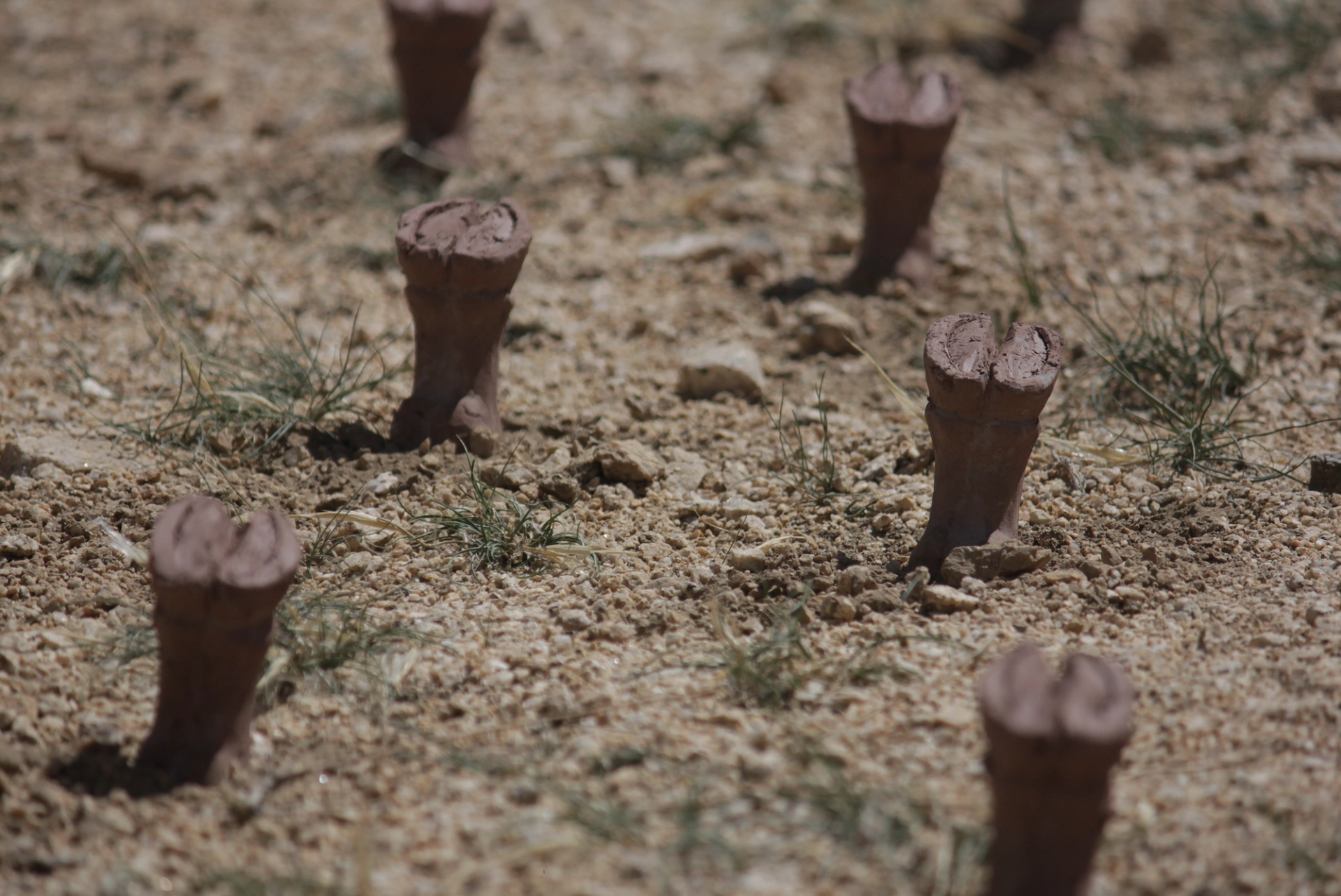
Tundup Churpon’s Vanishing Footprints (2023)
Courtesy of sā Ladakh
Moreover, its harsh winters, which can see temperatures plummet to -20C and blanket the region with snow, have historically forced communities to effectively “shut down for half the year”, presenting a model of de-growth that is only now being discussed in the Global North, Ahmed says. She adds that most Ladakhis are not opposed to increased infrastructure in the region—some of which includes green energy projects—but that it is important to “consider local knowledge of the land” when doing so.
Such knowledge, held by traditional communities in Ladakh for generations, is referenced in Tundup Churpon’s installation of small clay sculptures dotted on a hillside, resembling upturned sheep hooves. The ceramicist says that sheep and goat herding, and other agrarian ways of life, are being lost among modern generations, to the detriment of the environment. According to Churpon, sustainable grazing methods practised in Ladakh for centuries once helped to prevent the unseasonal flash flooding that inundated the region last month.
“We have lots to learn from previous generations,” Deachen says. “Traditional agrarian ways of life encourage biodiversity and help regenerate land, all of which is being destroyed by industrial farming and reckless development. We have to sustain what we already have, in the face of an increasingly globalised world.”
To achieve this, sā Ladakh and Local Futures are running a series of school workshops and other education programmes throughout the exhibition, focused on permaculture and indigenous sustainable building practices. In many cases, these workshops allow children to access knowledge that was commonplace understanding in their communities just three or four decades ago.
Traditional lifestyles are precisely what is being targeted when the government cites Ladakh’s “economic backwardness” as a key reason for encouraging rapid development in the region. Preserving forms of knowledge focused on regeneration and a slower pace of life certainly feels incongruous with a national project aimed at turbocharging India into a dominant player on the global stage.
Last month, India launched the Chandrayaan-3 lunar mission, which is expected to land on 23 August—coincidentally the day sā Ladakh closes. The project will “uncover mysteries of the universe” and “prove that India is not lagging behind other countries”, the nation’s science and technology minister Jitendra Singh said. As their necks crane towards the sky in search of new lands to explore, policymakers might equally consider how solutions to some of our most pressing issues lie closer to home, in the earth beneath our feet.
Sā Ladakh, Disko Valley, Leh, India, until 23 August