This article is featured in Bitcoin Magazine’s “The Inscription Issue”. Click here to get your Annual Bitcoin Magazine Subscription.
Click here to download a PDF of this article.
Ordinals have been a polarizing phenomenon for most every subcommunity in Bitcoin — except for miners.
The meteoric rise of the new Bitcoin-native NFT standard dominated discourse for months as Ordinals flooded blockspace and buoyed transaction fees to multiyear highs. According to critics, these transactions are, at worst, an attack on Bitcoin that tainted the sanctity of scarce blockspace; at best, they are shitcoins, the play-things of gamblers that belong on casino chains like Ethereum.
Well, miners don’t give a shit if they’re shitcoins. They give a shit about making money, and Ordinals gave them a revenue boost at a time when mining income was at one of its lowest points ever. So many miners have embraced — or at the least, are ambivalent about — Ordinals/inscriptions, since they received a much-needed boost to Bitcoin mining profitability when many miners were nearly breakeven or unprofitable.
Hashprice is a measure of the USD (or BTC) amount miners can expect to earn from a unit of hashrate (for example, at $80/PH/day, a miner with 1 petahash of mining rigs — roughly 10 new-gen ASICs like the S19j Pro, for example — can earn $80 per day).
Given their positive impact on hashprice, Ordinals, a darkhorse technical advancement that few could have predicted last year, have found themselves at the center of discussions regarding Bitcoin mining economics, discussions that are more germane with each block that pulls us closer to Bitcoin’s fourth block subsidy halving.
I’m not writing this to proselytize anyone into becoming an Ordinals enjoooyer. I, for one, don’t really understand the appeal. But I do think that they’re important in the context of Bitcoin’s ever-dwindling block subsidy, so they’re worth studying to understand how they affect blockspace and mining economics — and what developments like them might mean in a future where miners subsist solely on transaction fees.
WTF is an Ordinal, Anyway?
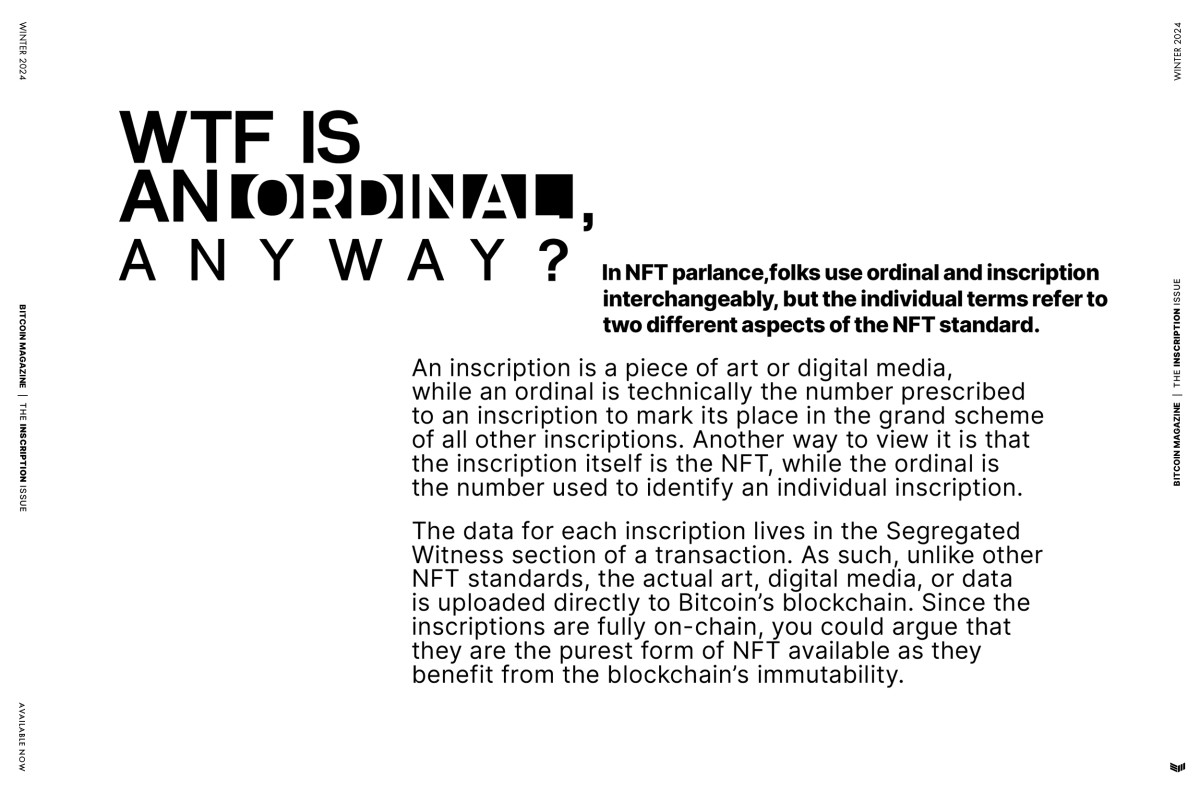
In NFT parlance, folks use Ordinal and inscription interchangeably, but the individual terms refer to two different aspects of the NFT standard.
An inscription is a piece of art or digital media, while an Ordinal is technically the number prescribed to an inscription to mark its place in the grand scheme of all other inscriptions. Another way to view it is that the inscription itself is the NFT, while the Ordinal is the number used to identify an individual inscription.
The data for each inscription lives in the Segregated Witness section of a transaction. As such, unlike other NFT standards, the actual art, digital media, or data is uploaded directly to Bitcoin’s blockchain. Since the inscriptions are fully on-chain, you could argue that they are the purest form of NFT available as they benefit from the blockchain’s immutability.
Not All Inscriptions Are Created Equal
When you understand that inscriptions are actual on-chain data, you can appreciate some of the critiques and concerns from detractors; if a bunch of NFT degens are inscribing monkey JPEGs and dickbutts and God-knows-what-else on-chain, then this crowds out economic (and potentially necessary) transactions.
This concern was aggravated by the fact that the arbitrary data for each inscription benefits from a transaction fee discount. As a scalability measure, Bitcoin’s Segregated Witness upgrade modified the transaction structure so that the witness data for a private key signature and public key was moved from the transaction hash field to another part of the block. Bitcoin discounts SegWit data, so it requires fewer satoshis per byte in transaction fees to transact. The arbitrary data for an inscription lives in the SegWit field of a transaction, so it’s entitled to the SegWit discount. Cue the pitchforks.
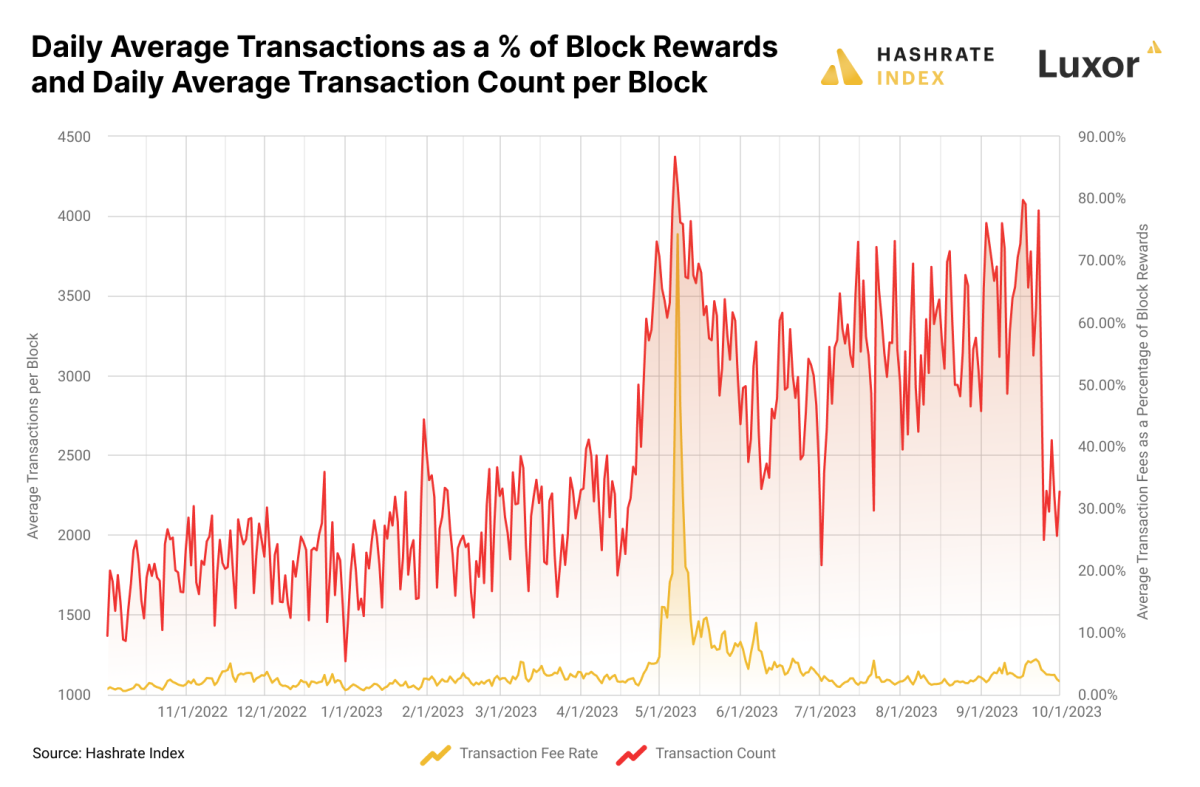
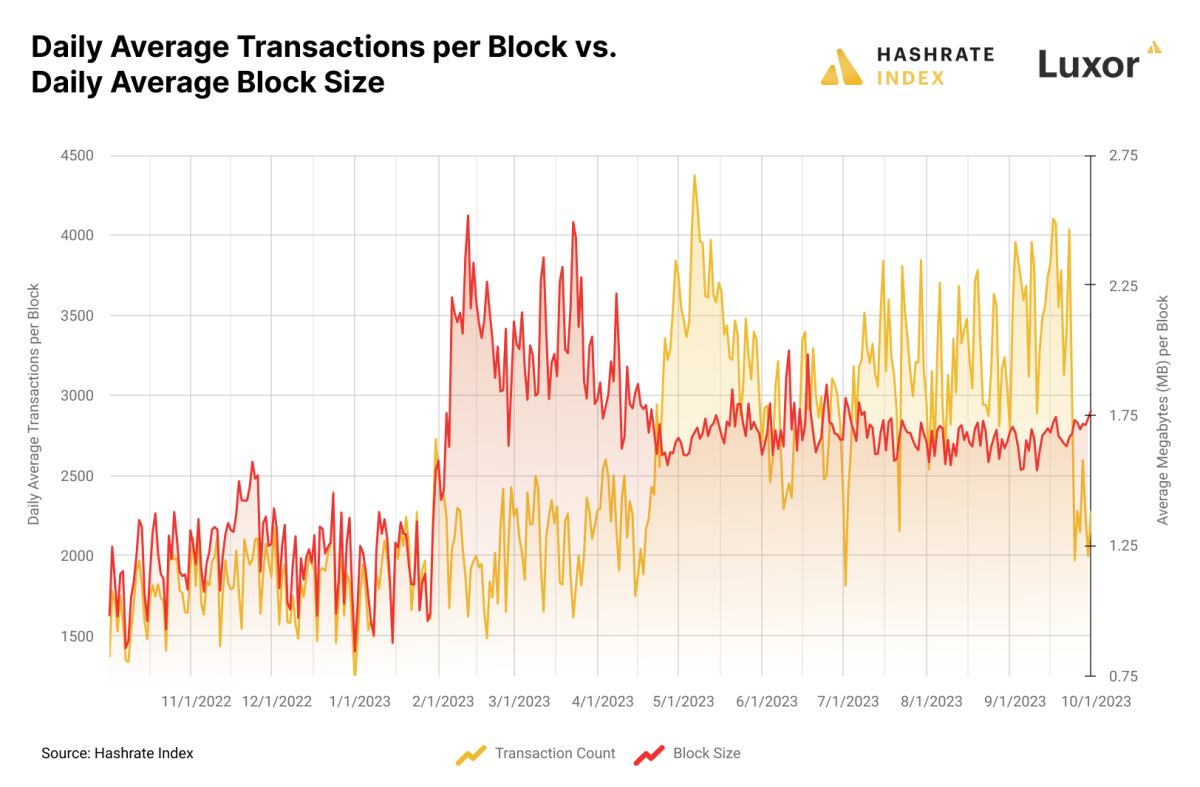
This discount is why, despite the first wave of image-based inscriptions clogging block space in February/March/April, transaction fees did not meaningfully increase; block sizes swelled when trendsetting inscribers flushed the blockchain with thousands of JPEGs for the first inscriptions collections, but these all benefited from SegWit’s 4-to-1 data discount versus normal transactions. Perhaps intuitively, it wasn’t until less data-heavy, text-based inscriptions from BRC-20 tokens became the most popular inscription type that transaction fees soared.
So-called BRC-20s (a nod to Ethereum’s own ERC-20 token standard) are a loose form of token. I say loose because they are really just Ordinals in a series defined by Bitcoin’s OP_CODE function, where each “token” is itself an OP_CODE transaction that defines the token’s place in the specific BRC-20 series. It goes like this: Someone (God only knows who) publishes an OP_CODE transaction that defines the token series’ max supply, ticker, and the minting limit per transaction. Once publicized, anyone with the technical know-how can mint tokens in the series.
These OP_CODE transactions do not benefit from SegWit’s data discount, so they cost a pretty penny more than image-based inscriptions. But they also have a feature that image inscriptions don’t: the minting function, which brings Ethereum NFT-esque incentives to collecting these inscriptions. Ethereum NFT series typically have minting contracts where anyone can create new NFTs in the series by interacting with the contract. This is part of — if not the entire — appeal. Minting an NFT is like opening up a digital pack of Pokémon/baseball/Magic: The Gathering cards — maybe there’s a rare card in this next one!
And while there isn’t necessarily the opportunity to mint a rare BRC-20 (because they are all the same), there’s the chance to mint a bunch of NFTs in a hot new series. Why anyone cares about having ORDI/CUMY/RATS #1 or #100 or whatever, I don’t know. Perhaps it’s the greatest expression of the greater fool theory yet in Bitcoin. But the fact is, they do, and the minting incentives for BRC-20s precipitated the largest wave of Bitcoin transaction activity ever.
Through a combination of fee wars and the fact that these NFTs don’t benefit from the SegWit discount, BRC-20s have catered a veritable fee feast for Bitcoin miners, but not exactly in the way you might think.
Quantifying Transaction Fee Collateral Damage
The bulk of transaction fee increases in 2023 has not come directly from fees associated with Ordinals; it has come from indirect fee pressure on other transactions.
Per data from independent analyst Data Always’ Dune dashboard, as of November 12, 2023, miners have raked in $70.3 million fees from Ordinals. Seems bigly, but it’s only 19.4% of the $368.2 million in transaction fees that miners have earned in total since inscriptions debuted on December 14, 2022. To put this into further perspective, there have been 40.2 million inscription transactions, which equates to 30% of all transaction volume since December 14. So inscriptions have accounted for one-third of transaction volume over the last year but only one-fifth of all fees.
As for the other fees, many of them are the result of indirect fee pressure from inscriptions — that is, fees that do not come directly from inscriptions themselves, but from the pressure that inscriptions exert on the average transaction fee needed to clear a Bitcoin transaction in a reasonable time frame.
Galaxy Digital Research examines this dynamic in a report titled “Bitcoin Inscriptions & Ordinals: A Maturing Ecosystem”. Rampant inscription activity congests the mempool. This is particularly true during BRC-20 minting events, as the first-come-first-mint incentivizes bidding wars as inscribers gun to be the first to mint a series. This raises the floor for average transaction fees and, as Galaxy Digital Research points out, precipitates transaction fee “overpayment” from various transactors. They define overpayment as any fee in a block that is greater than that block’s median transaction fee. For normal transactions, this overpayment could come from transaction fee estimators in wallets or on exchanges or from general user ignorance regarding transaction fee structure and dynamics. Some users may also need to expedite transactions for any number of reasons, leading to overpayment. For inscription transactions, Galaxy Digital Research says that “voluntary overpayment” was commonplace during times of high activity and popular inscription mints.
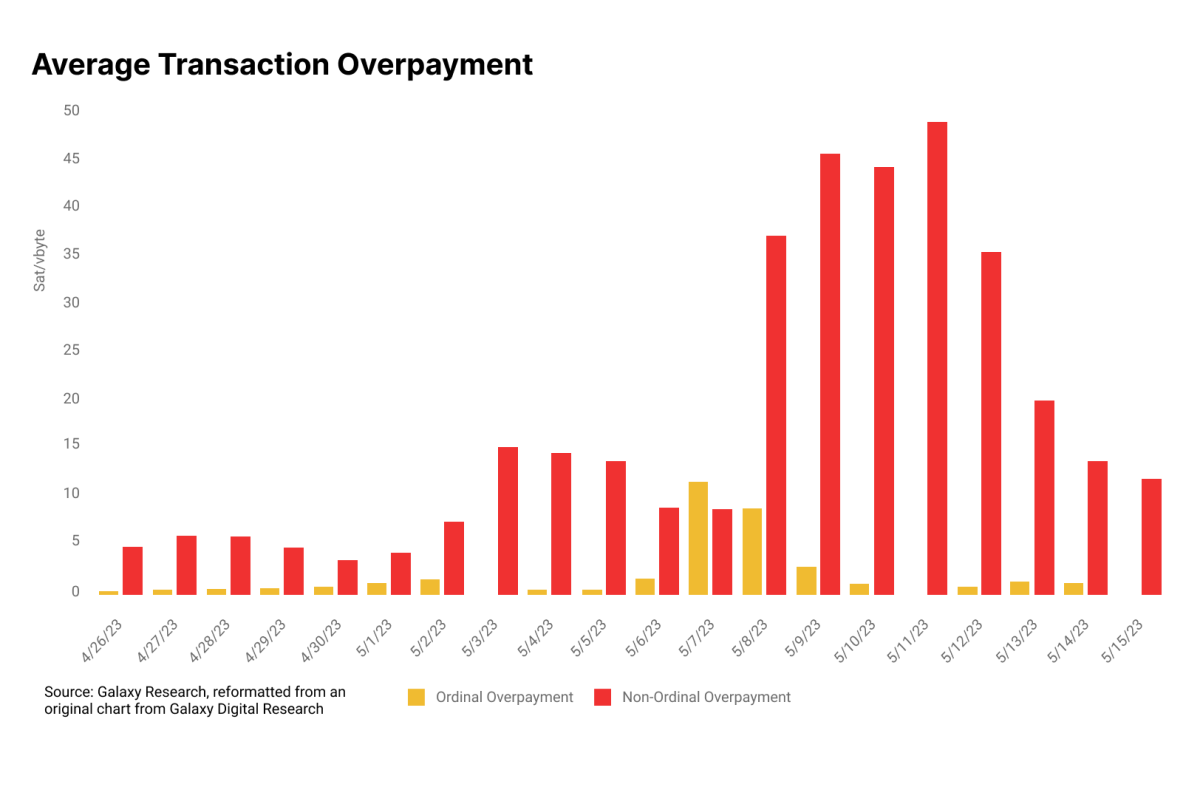
This chart quantifies overpayment for inscription transactions and all other transactions to demonstrate the dynamics Galaxy Digital Research outlines in their report. When Bitcoin’s mempool became backlogged in April and May — the hottest time frame for inscription activity so far — a majority of the transaction fees during this time actually came from user overpayment for financial transactions, not inscriptions themselves. These users could probably make it easier on themselves by not using built-in transaction fee estimators with their wallets and exchanges.
Blessing and a Curse
Inscriptions are a blessing and a curse. They’re a godsend for miners, but they can be a pain in the ass for other Bitcoiners, particularly those who have to send transactions on the network every day.
That said, blockspace is an open market. So I don’t have to like Ordinals to recognize that it’s not my place to police someone else’s spending. Nor is it my place to censor a transaction that pays for blockspace on the f(r)ee market. That’s part of the point of a permissionless blockchain, after all: to make transactions other people don’t want you to make.
This article is featured in Bitcoin Magazine’s “The Inscription Issue”. Click here to get your Annual Bitcoin Magazine Subscription.
Click here to download a PDF of this article.