In an age when an angry mob set a self-driving car on fire, it is fair to say that public sentiment about artificial intelligence (AI) is polarised. Harold Cohen: AARON (until 19 May) at the Whitney Museum of American Art is a mediation on technology’s ability to resurrect artists and offers much-needed historical perspective on AI’s capabilities and limitations. And, as its curator Christiane Paul points out, the exhibition also shows that AI-generated art is not a new development, but has been around for more than 50 years.
Cohen, who was born in London in 1928 to Polish-Russian Jewish parents, began coding AARON in the early 1970s. While its name hints at an elaborate acronym, it was in fact meant to be the first in what the artist imagined would be a series of programmes, with the second given a name starting with the letter B, the third with C and so on. This lettered naming sequence is an echo of the programming language of the era, which, called C, which was a successor to B. Instead of adopting a lettered nomenclature, the artist ended up working on iterations of AARON from 1972 until his death in 2016.
The paintings and drawings on display at the Whitney represent a wide range of works produced by different versions of AARON beginning in the 1970s, but the show’s most intriguing components are the four live demonstrations of the AI software generating new output daily: there are the two digital works presented on projections, AARON Gijon (2007) and AARON KCAT (Kurzweil CyberArt Technologies, 2001), and two mechanical demonstrations, one of which is also running AARON KCAT. The fourth is a different software called Mazes that generates abstract lines that do not touch one another, implying the availability of “pathways” to navigate between the labyrinthine marks.
Installation view of Harold Cohen: AARON, Whitney Museum of American Art, New York, until 19 May. From left to right: Untitled, 1982; Untitled [Amsterdam Suite], 1978; active plotters drawing images from different periods of the AARON software. Plotter fabricated by Bantam Tools; courtesy Bre Pettis. Photograph by Ron Amstutz
Both of the mechanical demonstrations are capable of monochromatic output using a single stylus, and they were “resurrected” for the purposes of the show by Cohen’s son, Paul Cohen, who is the University of Pittsburgh’s dean of computer sciences. He rewrote the code for the plotters in Python.
The process of rewriting the code raised questions of authorship, Christiane Paul says, acknowledging that a genuine Harold Cohen work requires three things: Cohen himself, a version of AARON and Cohen’s process. “Cohen built and tuned the AARON code to reflect how he thought about creating images, selected images, adjusted colour and built drawing and painting machines,” she says. “The amount of control he ceded to AARON changed throughout his life according to his interests as an artist and it was not his intent to establish a process that could run without him.”
At the Whitney, the projected AARONs’ outputs are transient. The large-scale projection of the AARON Gijon displays a continuously generated, gargantuan, luscious landscape filled with neon-hued plants that keeps regenerating itself as if it is being painted over. The second live version of Cohen’s AI on display, AARON: KCAT AARON 2.1.010719 (2001), generates images more similar to works on canvas and paper, featuring portraits and domestic still lives in a somewhat smaller projection. Cohen also created a screensaver version of the software in 2001, in collaboration with the computer scientist Raymond Kurzweil, in his effort to make art more affordable.
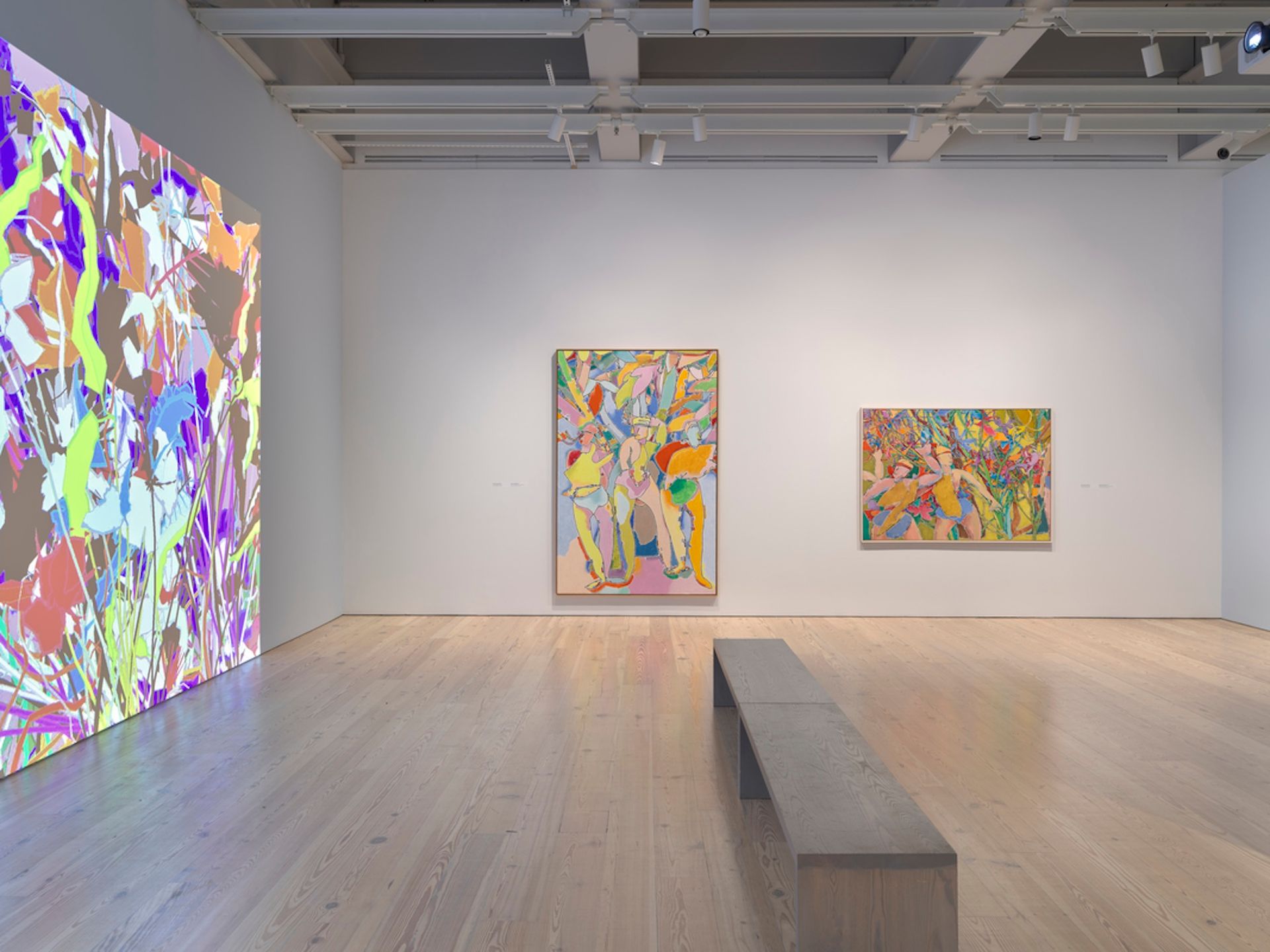
Installation view of Harold Cohen: AARON, Whitney Museum of American Art, New York, until 19 May. From left to right: AARON Gijon, 2007; Coming to a Lighter Place, 1988; Untitled, Bathers Series, 1986. Photograph by Ron Amstutz
Watching Cohen’s machines “think” so quickly in the projections makes one assume the displays are of a sped-up screen recording. Even after reading the works’ wall text it is difficult to process the fact that a machine is making a digital painting so rapidly and discarding it or painting over it without hesitation seconds later. The show is less preoccupied with the contemporary topics of delegated labor or copyright, and more mindful about authorship and digital impermanence.
The transience of the projected AARONs’ outputs is mitigated in the next gallery, where analog AARON KCAT drawings are generated on A3 sheets of paper by plotters Cohen affectionately named “turtles”. The resulting works have a Whitney stamp on them and are signed and dated by a technician in overalls, who then hangs them on a wall with magnets, to echo the atmosphere of an artist’s studio where everything is treated as output, rather than a final piece. With Mazes running in a separate plotter next to AARON KCAT, the Whitney will have accumulated thousands of drawings by the end of the exhibition. The museum plans to keep a few examples while giving the majority to the Cohen family trust. By not exalting the output, this exhibition acknowledges the open-ended question of what it might mean for a museum to be able to produce infinite works of art by a dead artist.
The live elements of the exhibition evoke glimpses into Cohen’s studio, although in his absence the lack of a decision-making artist renders the AARONs’ efficiency doleful and strangely futile, resembling an avant-garde version of the famous cleaning scene in Fantasia.
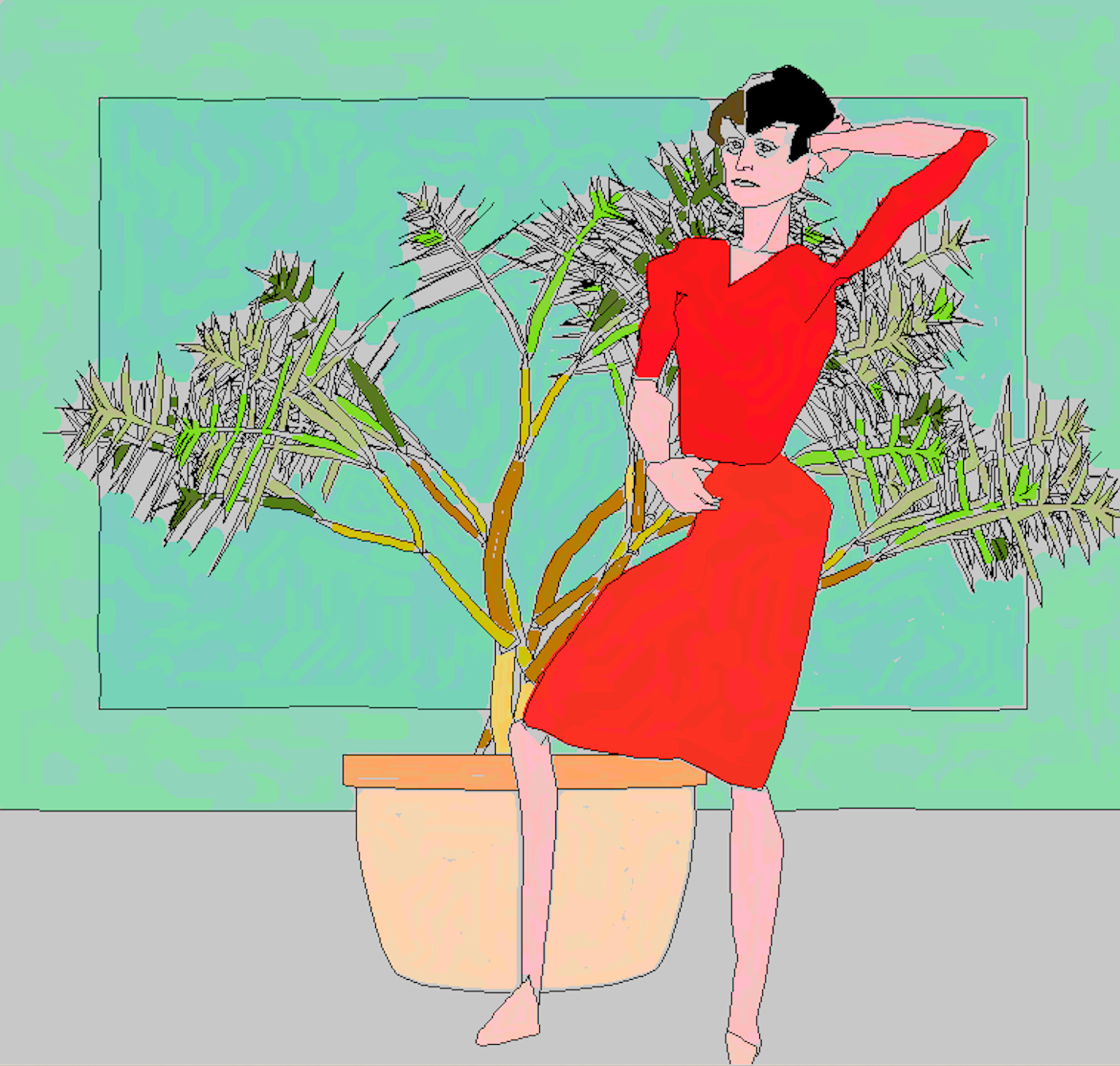
Harold Cohen, AARON KCAT, 2001. Screenshot. Artificial intelligence software. Dimensions variable. Whitney Museum of American Art, New York; purchase, with funds from the Digital Art Committee. © Harold Cohen Trust
On his perceived absence and questions of authorship, Cohen made a case for his continued presence in the software in a brochure from 1972 that is on display at the Whitney: “‘the machine’ which is driving the plotter is actually a complex: device + system + programme. And since the user supplies the programme, he is in a real sense present, even part of the machine, while it is running.”
Like all AI-generated works, Cohen’s images made with AARON inevitably contain biases. What is interesting about AARON is that, unlike today’s generative models, it was never trained on large swaths of data, statistics or even images. Instead, AARON is a symbolic AI, and Cohen trained it on a set of rules, using code to get a mechanised arm with a stylus attached to initially create child-like drawings inspired by and reminiscent of petroglyphs and abstract mazes. There is a fascinating looseness to these smaller, early works; they show that a machine in the 1970s or 80s could doodle, generating seemingly unstructured and plausibly natural imagery.
The chiseled, angular and somewhat blasé faces of the figurative drawings Cohen subsequently trained AARON to generate, appear much more plausibly mechanical. For these, Cohen coded in the proportions of the body. In the same room as the plotter turtles, a detailed anatomical drawing of an arm with countless little notes and dots shows each point Cohen taught AARON, marking the ideal distances between the fingers and the wrist, or where the elbow is and which way it can bend, for example. The line style, body language and the compositions of this era of AARON imagery are reminiscent of 1960s and 70s European comic books, or perhaps Peter Chung’s Æon Flux, colliding with Microsoft Paint.
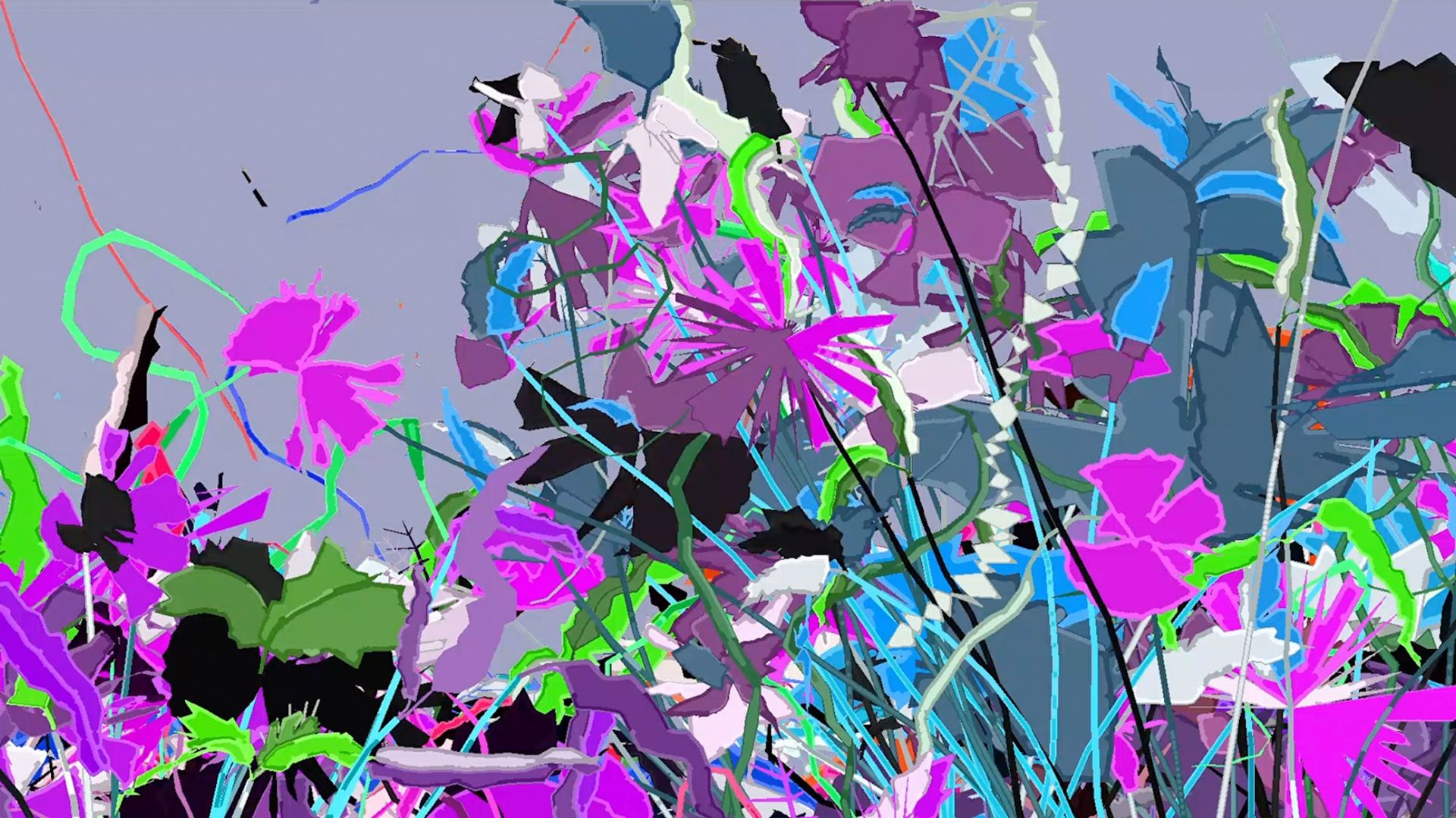
Harold Cohen, AARON Gijon, 2007. Screenshot. Artificial intelligence software. Dimensions variable. Whitney Museum of American Art, New York; purchase, with funds from the Digital Art Committee. © Harold Cohen Trust
While the women in Cohen’s figurative works are majestic, sometimes filling up the foreground and imbuing the works with a powerful presence, the oftentimes smaller male forms, with their slender physiques and V-necked jumpers, present a kind of elated queerness that Christiane Paul also recognised, remarking that the 1970s were, in fact, quite queer. There is no discernible sexual orientation to these figures, and the dominant theme is a kind of liminal romanticism, depicted through a floral pastiche or a domestic setting occupied by figures who are almost always young adults, looking terribly stylish and somewhat lost in thought.
Compositionally, some of the works are reminiscent of David Hockney, however unlike in Hockney there is a deliberate and quite mesmerizing flattening of the planes, accomplished through a total lack of shading. As far as AARON is concerned—and coded for—depth and distance are best conveyed through size.
One question that looms over the show is why a white, cisgendered and able-bodied British man from the 20th century should get to determine an AI’s notion of a default human? It is a tricky proposition in 2024. But, unlike generative AI tools developed by Midjourney and others, AARON is not a tool available for a global paying public with diverse and conflicting expectations of the technology. AARON is an extension of Cohen and it is even somewhat romantic to see traces of the artist in its figurative output.
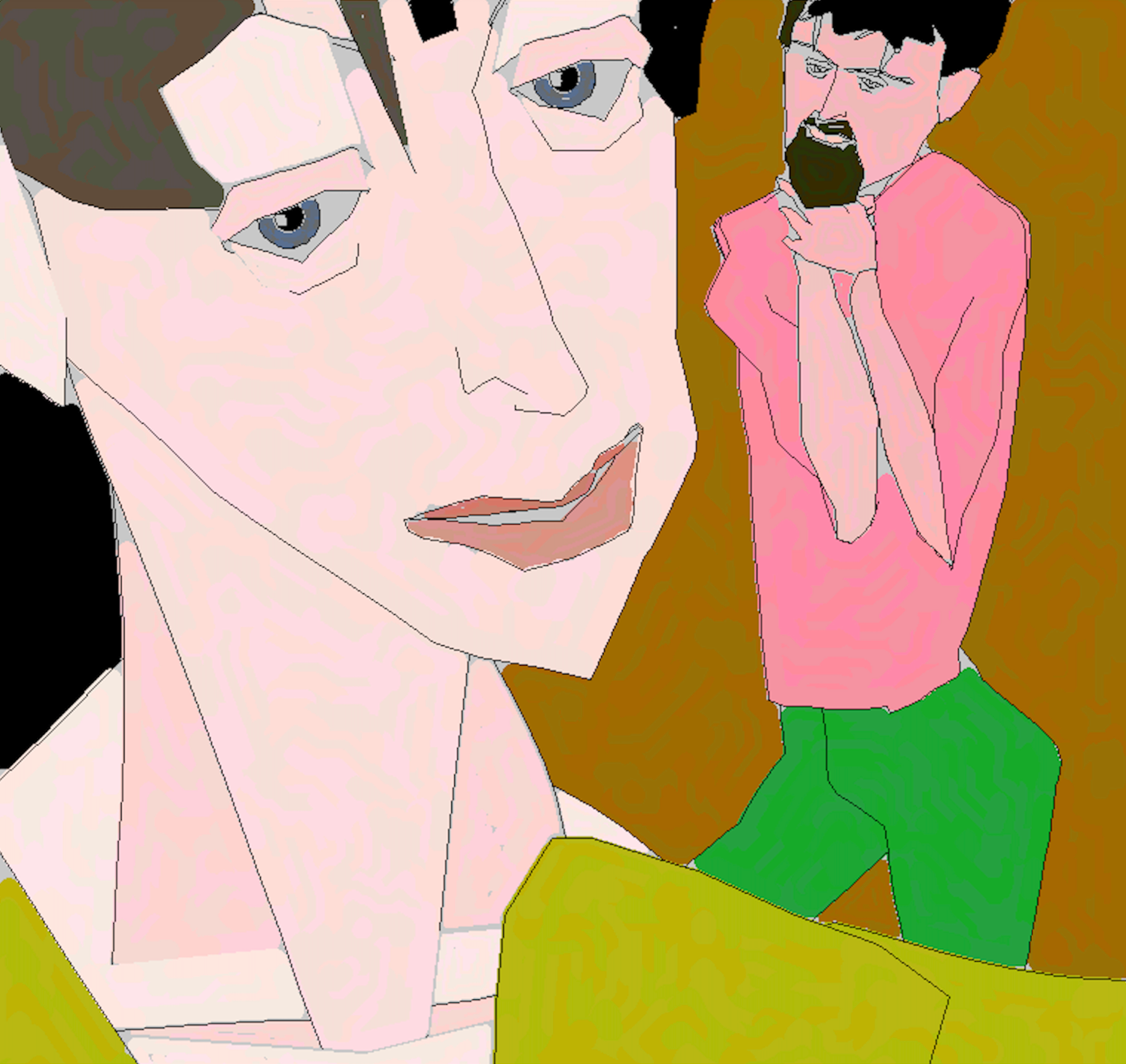
Harold Cohen, AARON KCAT, 2001. Screenshot. Artificial intelligence software. Dimensions variable. Whitney Museum of American Art, NewYork; purchase, with funds from the Digital Art Committee. © Harold Cohen Trust
Given the lack of diversity in today’s generative AI creations and Google’s recent contentious overcorrection, it is a relief to see throughout the show figures that represent, at the very least, a range of races, sometimes hand-painted by Cohen himself over the outlines of the AARON’s iterations. Later versions use a colour palette, warm and wildly rich, breathing extraordinary life into the works that, in the outlines generated live on paper, seem and feel more calculated. The precision with which the mechanised arms wield the Sharpies, the closest available marking tool to what Cohen originally used, evokes a level of confidence few humans possess with a permanent marker. The acoustics of the mechanical AARONs’ production meld the pleasant whirring and whizzing of the turtle mechanisms with the unsettling squeaking of the Sharpie tip on paper.
The Whitney exhibition is both timely and overdue. Some visitors’ expectations, having been shaped by the endless barrage of glossy generative AI imagery created and disseminated over the last two years, will likely be shattered by the earthy textures and warm primary colours of the AARONs’ portraits. Images featuring analog painting within mechanically-plotted outlines of figures and plants serve as a counterbalance, imbuing the AI-generated work with what the United States Copyright Office might call “sufficient human intervention”.
The exhibition “highlights the difference between symbolic and statistical AI, and how they play out in terms of authorship and agency,” Paul says. With AARON, Cohen was in control. While today’s statistical AI models are programmed to make generalisations, symbollic AI follows a set of rules to iterate.
In a way, the star of the exhibition is Harold Cohen’s ghost, living on through the AARONs. And while the works generated over the course of the show may not be considered true Cohens, there is enough of him in them to make any artist pondering immortality a little jealous.
Harold Cohen: AARON, Whitney Museum of American Art, New York, until 19 May